
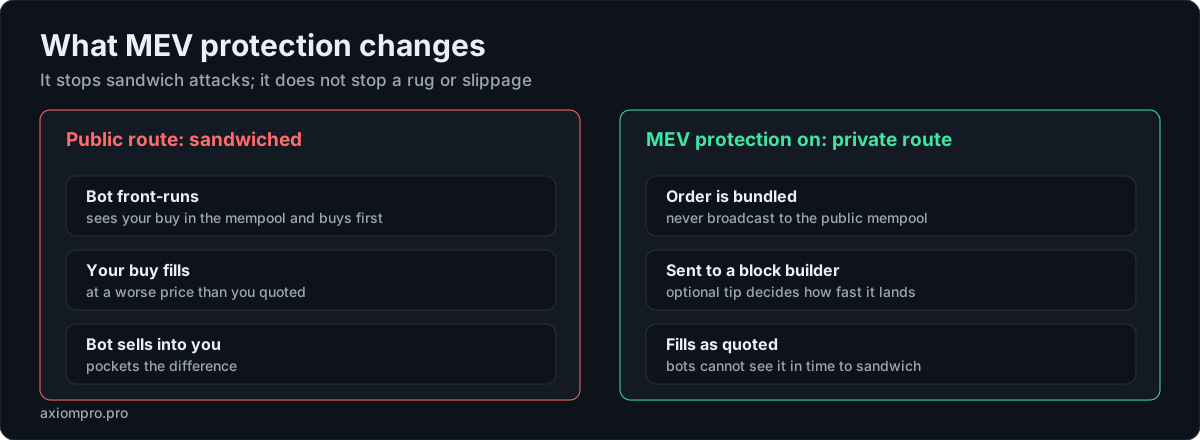
Every time you buy a memecoin on a public Solana RPC, bots can see your transaction before it lands, buy ahead of you, and sell into your fill. That is a sandwich attack, the most common form of MEV on Solana, and it can cost several percent on a thin pool. Axiom's MEV protection is the setting that stops it.
What MEV protection actually does
With the toggle on, Axiom does not broadcast your transaction to the public mempool. It sends the bundle through private routing to block builders, most of it via Jito, so the transaction is not visible to searchers until it is already in a block. Bots cannot front-run what they cannot see.
You still pay Solana's base fee and your priority fee. The optional tip (Axiom calls it a bribe in the preset panel) goes to the block builder to prioritise your bundle. On quiet blocks a small tip is enough; on a contested launch a bigger tip is the difference between block one and block three.
What it does not do
- It does not protect against a rug. If the deployer pulls liquidity, no routing helps.
- It does not fix slippage on a thin pool. Your own order moves the price.
- It does not guarantee speed. Private routing can be marginally slower than a raw public send when the network is idle.
Cost of leaving it on
There is no platform fee for MEV protection. The only cost is the tip, which you control, and a small latency overhead on quiet blocks. For most traders that trade is obviously worth it: losing 3 to 8% to a sandwich on every buy is far more expensive than a tip of a fraction of a cent.
When turning it off makes sense
Rarely. Two situations:
- Deep-liquidity tokens where a sandwich is unprofitable for the bot anyway, and you want the absolute fastest send.
- Diagnosing failed fills during extreme congestion, to rule out bundle rejection as the cause.
Turn it back on afterwards. The default should be on.
Recommended preset settings
| Setting | Quiet market | Hot launch |
|---|---|---|
| MEV protection | On | On |
| Priority fee | Low | High |
| Tip / bribe | Minimal | Meaningful; scale with size |
| Slippage | 5 to 10% | 15 to 25% |
Axiom lets you save three presets, so keep one for each condition and switch with a click. Full preset guidance in the sniper guide.
How Axiom compares
BullX and Photon offer equivalent private routing; this is table stakes for Solana terminals now. What differs is how the tip and priority fee are exposed in the UI. Axiom puts both on the preset itself, which makes it harder to forget them on a fast buy.
Bottom line
Leave MEV protection on, set a sensible tip per preset, and stop worrying about sandwiches. Spend the attention you save on the checks that actually prevent losses: holders, dev history, liquidity and an exit plan. See Axiom limit orders for the exit side.